Answer Engine Optimization

As AI-powered answer engines reshape how people find information, a new discipline has emerged alongside traditional SEO. Answer Engine Optimization is the practice of making your content the source AI systems cite, quote, and surface — not just the page someone clicks to visit.
What Is Answer Engine Optimization?
Answer Engine Optimization (AEO) is the strategic practice of structuring, formatting, and positioning content so that AI-powered answer engines — including ChatGPT, Google's AI Overviews, Microsoft Copilot, Perplexity, and voice assistants — select it as the authoritative source when responding to user queries.
Where traditional SEO asks: How do I rank on the first page of Google? — AEO asks a fundamentally different question: How do I become the answer? The distinction matters enormously. In a world where users increasingly receive direct, synthesized responses rather than a list of links to browse, visibility is no longer guaranteed just by ranking. You must be cited.
The rise of large language models (LLMs) and AI-powered search has created a new layer of digital gatekeeping. These systems scan the web, evaluate sources, synthesize information, and deliver a single, confident answer — often without the user needing to visit any website at all. AEO is the discipline of ensuring your content is what those systems choose to draw from.
"Traditional SEO gets you to the door. AEO gets you inside the conversation."
Why AEO Is a Product of Its Moment
The shift toward answer engines did not happen overnight. It is the culmination of two decades of search evolution — from keyword matching, to semantic understanding, to natural language processing, to generative AI. Each step moved search further away from returning documents and closer to delivering answers.
Several converging forces have made AEO urgent in 2026:
The Generative AI Disruption
ChatGPT's public release in late 2022 demonstrated mass-market appetite for conversational AI that synthesizes information on demand. Within months, every major search engine was racing to integrate generative AI into its core product. Google's AI Overviews now appear for a substantial portion of queries. Microsoft's Bing is built around Copilot. Perplexity has built an entire search product on AI-generated answers with citations. The era of answer engines is not approaching — it has arrived.
The Zero-Click Phenomenon
Before generative AI, zero-click searches — queries where users got their answer directly from the SERP without clicking through — were already growing. Featured snippets, knowledge panels, and instant answers had been reducing click-through rates for years. AI Overviews have accelerated this trend dramatically. For many informational queries, the search results page is now the destination, not the gateway.
Voice and Ambient Search
Voice assistants return a single verbal answer to spoken queries. There is no position two, no alternative link to explore. Either your content is the answer or it is invisible. As voice search expands through smart speakers, earbuds, in-car systems, and ambient computing devices, the stakes of being the chosen source rise accordingly.
How Answer Engines Select Their Sources
Understanding AEO requires understanding how LLM-based answer engines evaluate and select content. While the exact algorithms vary by system and are not fully transparent, several consistent patterns have emerged through research and observation.
Authority and Trust Signals
Answer engines heavily favor content from authoritative, established sources. Domain authority — built through years of quality content, inbound links from credible sites, and consistent publishing — remains a foundational signal. A first-person expert article on a well-regarded industry site will be favored over the same information on an unknown domain, regardless of which ranks higher in traditional search.
Structured, Scannable Content
AI systems process content programmatically. Content that is clearly structured — with descriptive headings, well-organized paragraphs, defined terms, and logical flow — is easier to parse, extract from, and cite accurately. Content that buries its key point in a wall of text is harder to use as a clean source. Headers that mirror the way users phrase questions are particularly valuable.
Direct, Concise Answers
Answer engines look for content that actually answers questions — clearly and early. If a user asks "What is AEO?", the ideal source leads with a crisp, complete definition before expanding into detail. Content that makes users scroll past multiple paragraphs of preamble to reach the answer is less likely to be selected as the source for that answer.
Schema Markup and Structured Data
Structured data in the form of Schema.org markup gives search engines and AI systems explicit, machine-readable context about your content. FAQ schema, HowTo schema, Article schema, and Product schema all help answer engines understand what your content is about and how to categorize and surface it. While schema alone does not guarantee AI citation, it reduces friction and ambiguity for the systems evaluating your pages.
Freshness and Factual Accuracy
AI systems that have access to real-time or recent web content — such as Perplexity and Google's AI Overviews — weight recency for time-sensitive queries. Outdated statistics, deprecated information, or factual errors reduce the likelihood of selection and increase the risk of being filtered out. Keeping key content current is not just good publishing practice; it is an AEO requirement.
01 Question-First Structure
Lead every section with a direct answer to the question it addresses. AI systems extract answers — give them clean ones to extract.
02 Deep Topical Coverage
Comprehensive content on a topic signals authority. Cover a subject from every angle relevant to your audience's questions.
03 Schema Implementation
Mark up FAQs, how-tos, articles, and products with structured data. Reduce ambiguity for AI parsers.
04 E-E-A-T Signals
Author credentials, citations, institutional affiliations, and verifiable expertise all strengthen trust signals that AI systems evaluate.
05 Conversational Keyword Alignment
Optimize for how people speak and ask, not just how they type. Natural language queries are now the norm.
06 Content Freshness Cadence
Establish a regular review and update cycle for your most important pages. Stale content loses favor with real-time AI systems.
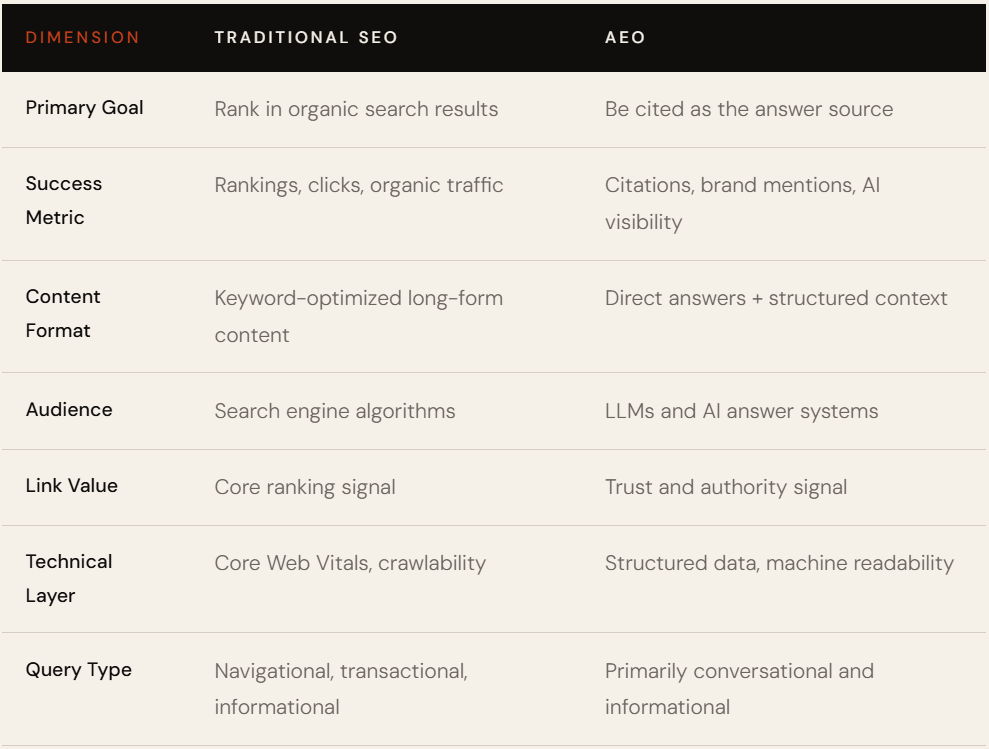
AEO vs. SEO: Distinct but Complementary
AEO is not a replacement for SEO — it is an evolution of it and an extension alongside it. The two disciplines share many foundational practices and reinforce each other. But they diverge in important ways that require intentional strategic planning.


Download The Complete Guide To SEO - 2026